
Case StudyBuilding the Membership Engine
A 280K-subscriber spiritual-community business needed to turn free YouTube viewers into a recurring-revenue community. Over eight weeks, I built the complete operating engine.
Full Integration · 8 weeks · All four engine layers
The BusinessWhat they had.
The business was a popular YouTube channel — 280K+ subscribers, 1.2 million monthly views, weekly livestreams, a small but real audience on Instagram and TikTok. The founder had spent years building genuine reach. People showed up, watched, commented, came back.
What they had built was an audience.
What they hadn't yet built was a business.
What was working.
The content engine was strong. The founder had a recognizable voice, a clear brand, weekly programming, and a small team running production. New videos went up reliably. The audience trusted them.
A small paid membership existed (a community platform with a free tier and a $39/month paid tier) but conversion from the YouTube audience to the paid community was happening only by accident. There was no funnel between them. People who wanted to become paying members had to find their way there themselves, which most of them never did.
Revenue was real but flat. Member count was modest relative to the size of the audience. The free tier had members but not engagement. The paid tier had members but no system for converting more.
What was broken.
The founder was the bottleneck. Every content decision, every member question, every operational issue, every hire, every billing problem — all of it routed through one person. The team had grown to a handful of contractors and one full-time hire, but there was no operating rhythm holding them together. Decisions happened in DMs. Tasks lived in someone's head. Nobody had a clear scorecard for what they owned.
There were no dashboards. No one could answer the question "is the business growing?" without opening five different tools and digging for data.
There was no funnel. The audience existed; the business existed; nothing connected them.
This is the most common shape of a business at this stage: real audience, real revenue, real team, and an operating layer that hasn't caught up to any of them.
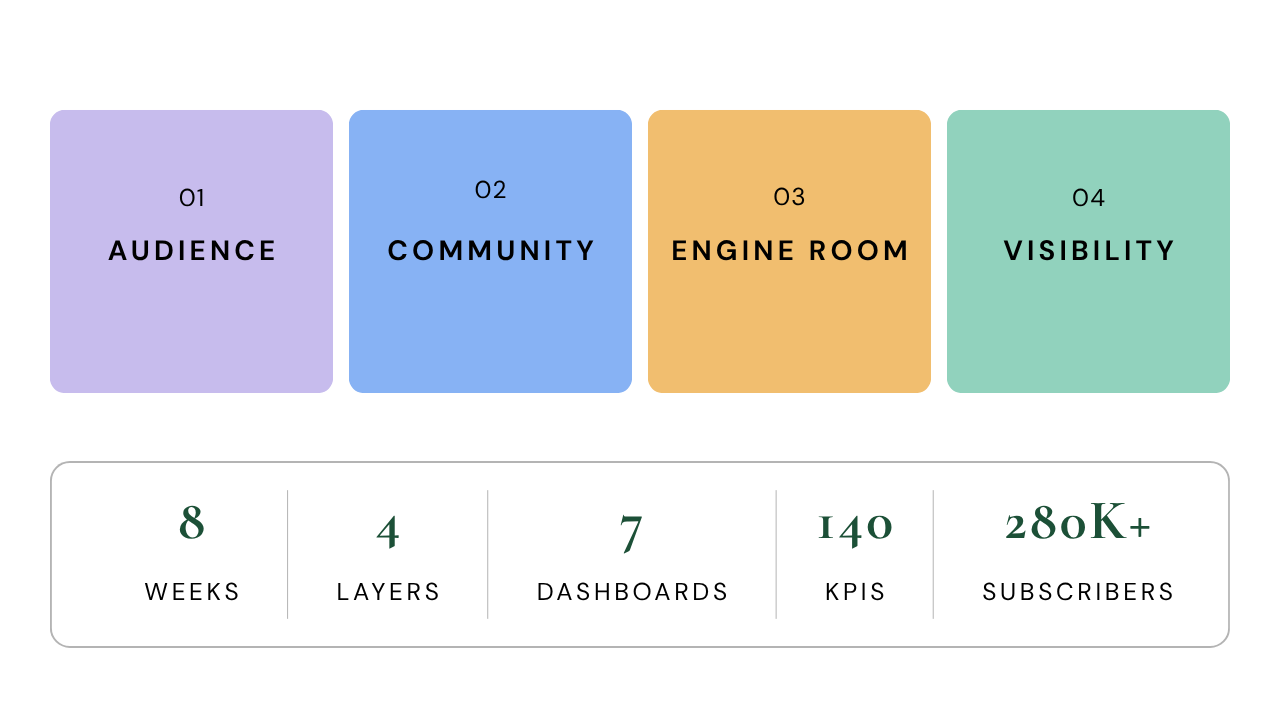
The DiagnosisI started where I always start: the four layers of The Membership Engine. In my first week, I audited the business across all four — what existed, what didn't, what was working, what was leaking — and produced a single-page diagnostic that became the spine of the entire engagement.
01 - AUDIENCE
A funnel that didn't exist. Traffic on five platforms with no path to paid.
02 - COMMUNITY
Free and paid tiers existed, but no onboarding, no rhythm, no shared system.
03 - ENGINE ROOM
No operating system. Decisions in DMs, tasks in someone's head, no scorecards.
04 - VISIBILITY
Real data scattered across five tools. No single picture of the business.
Why all four.
A funnel without dashboards leaks invisibly. A dashboard without a funnel measures the wrong things. An operating system without a content engine has nothing to operate. A content engine without an operating system burns out the founder.
The reason this engagement was eight weeks instead of three was that the four layers had to be built together, and they had to be designed to talk to each other.
The BuildFour layers, designed to talk
A four-tier funnel from cold traffic to paid member
01 - AUDIENCE
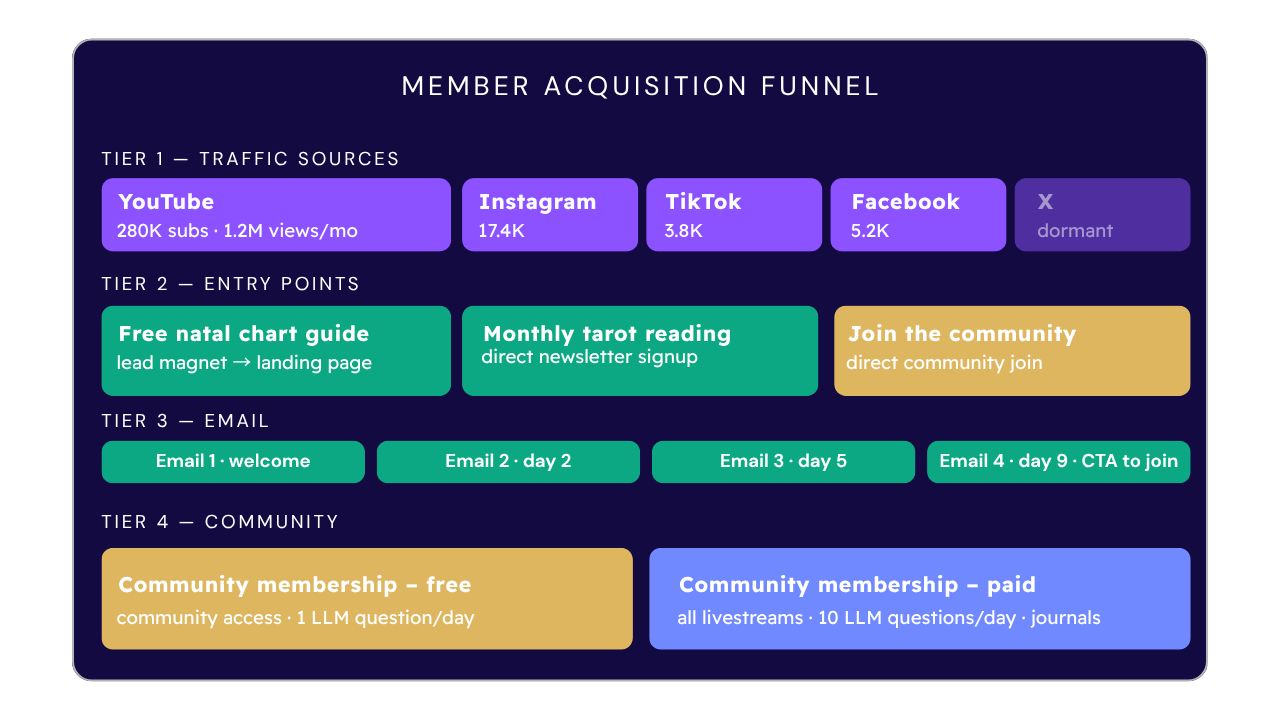
Tier 1 — Traffic. Five platforms (YouTube as primary driver, Instagram, TikTok, Facebook, X). Every platform's link-in-bio pointed to a single Linktree. The Linktree was redesigned from "list of links" into three explicit entry points, each with a different purpose: a free natal chart guide (the lead magnet), a monthly tarot reading (newsletter signup), and a direct community join.
Tier 2 — Email list. A 4-email nurture sequence triggered on lead-magnet opt-in. Two ongoing newsletter sends per month — an energy forecast on the 1st, a tarot reading on the last Friday. Distinct Kit tags for different audiences (cold opt-in, direct newsletter signup, YouTube member, paid community member) so messaging could be segmented without overlap.
Tier 3 — Free community member. A free tier with a structured onboarding sequence: an immediate welcome email, a pinned welcome post in the community, a "Start Here" orientation post, and pinned community guidelines. Limited access to the community's AI Oracle (1 question per day) — designed so the limit itself became the upgrade trigger.
Tier 4 — Paid community member. $39/month or $350/year. Full Oracle access, the full archive, livestreams, journal features. A clear and visible upgrade path from the free tier.
The funnel was designed so each tier earned the next. Email gave a reason to join the free community. Free community membership gave a reason to upgrade. The tarot reading ladder ran through everything: Instagram showed a card name, email delivered a 1-card reading, the community delivered the full 3-card spread. Each level gave you something the level below didn't.
I also designed a separate path for YouTube paid members, who skipped the lead magnet entirely (they were already a high-intent audience) and went directly into a warmer onboarding flow.
An onboarding system and a content rhythm
02 - COMMUNITY
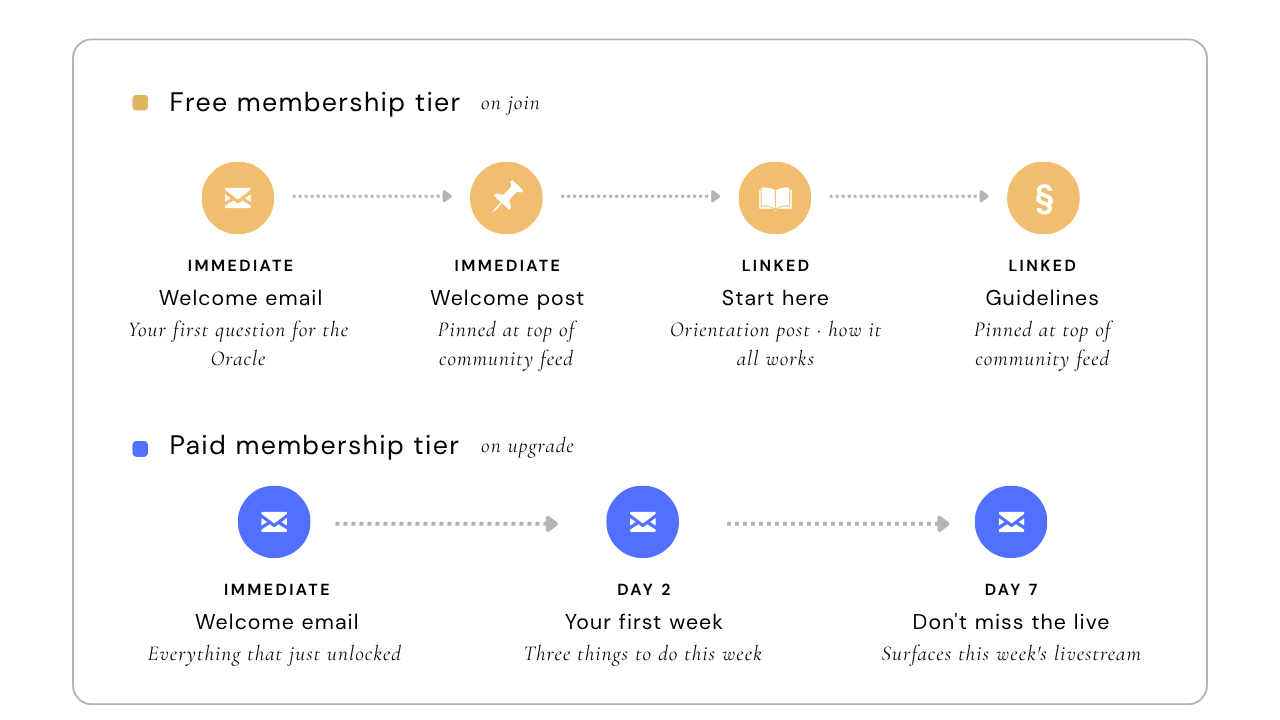
The community layer was a redesign of how the existing platform actually functioned.
I built the onboarding sequences for both tiers — the immediate emails, the pinned welcome post, the Start Here orientation, the community guidelines. I designed the content calendar: three tiers of community content (anchored, floating, reactive) running on different rhythms. Anchored content (energy forecast, tarot reading, moon ritual threads) ran on fixed dates that never moved. Floating content (teaching posts, conversation starters, instructor amplifications) ran on a flexible weekly cadence. Reactive content (prediction logged, prediction verified) ran when events happened.
I documented post-type templates for each, so the team could produce content without having to design each post from scratch. The tarot reading ladder I'd designed in the funnel layer continued here — the 3-card spread that hit the community two days before the email reading became a tangible benefit of being a member, not just an offer in marketing copy.
A complete operating system the team could run themselves
03 - ENGINE ROOM
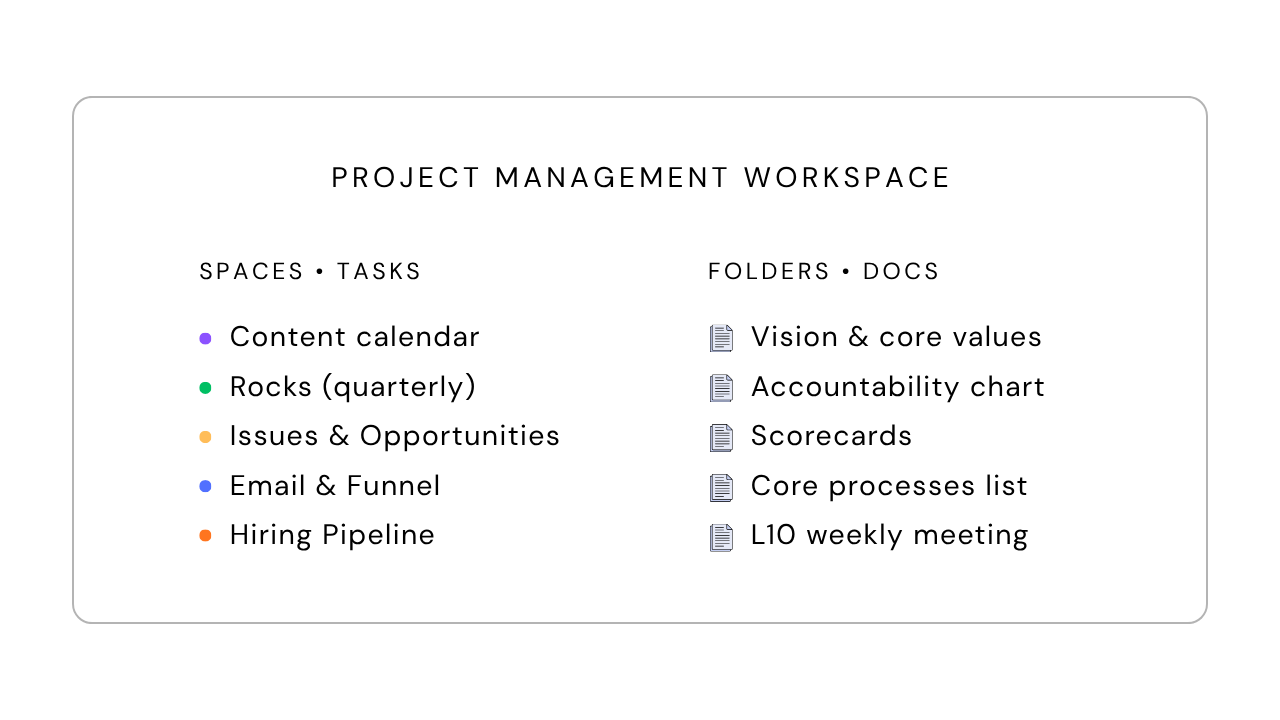
The engine room was the largest single piece of work. I built the complete operating system.
Project management. A custom ClickUp workspace with nine task lists (Content Calendar, Sprint Priorities, Issues & Opportunities, Email & Funnel, Automations, Hiring, Team & HR, Instructor Pipeline, General Ops) and nine doc folders. Every space had a purpose; no space duplicated another.
"EOS-lite" framework. A working adaptation of the Entrepreneurial Operating System (EOS) for a small online business — small enough that a full EOS implementation would have been overkill, big enough that no operating framework would cause it to fall apart. The framework included a one-page Vision & Core Values document, an Accountability Chart naming who owned each function, Scorecards (every role owns one number), Quarterly Rocks (three to five priorities per role per quarter), and a Core Processes List naming the six to eight processes that actually run the business.
Weekly meeting structure. A 60-minute L10 agenda: Segue, Scorecards, Rocks review, Headlines, To-dos, IDS (Identify, Discuss, Solve), Conclude; designed so the Director of Operations could facilitate it and the founder could participate without facilitating.
The operating system was designed so the team could run it without me in the room – that was the whole point.
I designed seven custom dashboards for Airtable, each tracking a specific dimension of the business, totaling 140 KPIs:
1. Funnel Metrics — Linktree clicks, opt-in rates, free and paid signups, MRR, churn, free-to-paid conversion.
2. Financial Operations — Cash, ARR, week-over-week deltas, dunning recovery, failed payments, automation status.
3. Campaigns — Active and upcoming email campaigns, sequence health, conversion, revenue per campaign.
4. Team & Contractors — Headcount, open roles, contracts current, 1099s on file, SLA breaches.
5. Instructor Pipeline — Active instructors, vetting, contracts, monthly appearances.
6. Vendors & Subscriptions — Monthly SaaS spend, annual commitments, renewal calendar.
7. Team Lifecycle — Hiring pipeline, time-to-fill, offer acceptance rate, onboarding compliance.
Each dashboard had a specific weekly user and a specific weekly question it answered. Nothing was a vanity metric. Every KPI was tied to a decision someone would make.
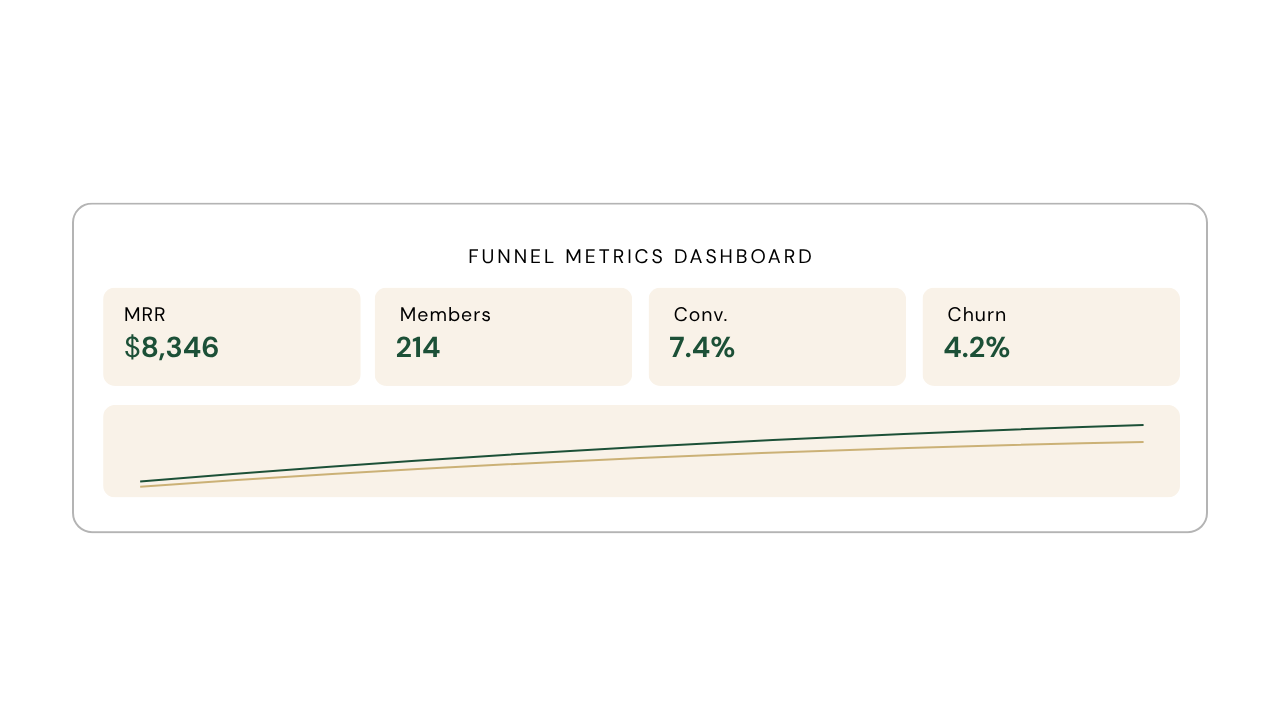
Seven dashboards, 140 KPIs, one picture of the business
04 - VISBILITY
The IntegrationThe four layers weren't built in isolation. They were designed to feed each other.
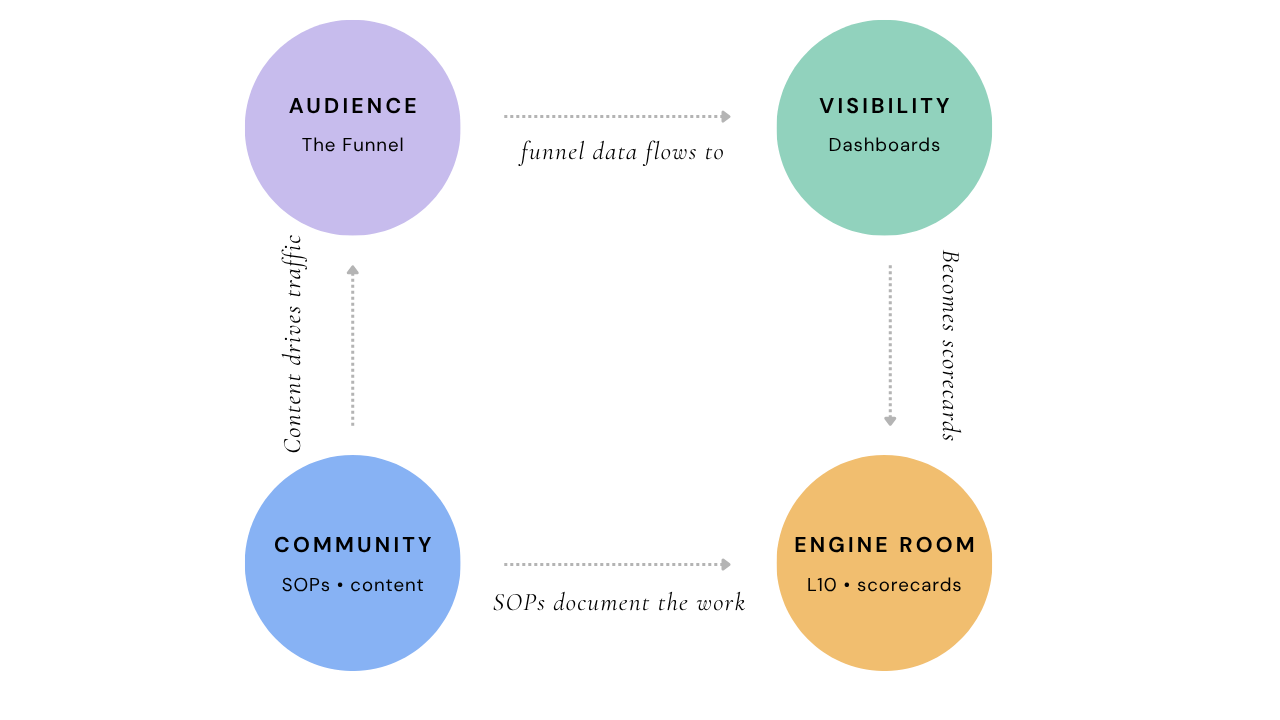
The funnel produced data that flowed into the dashboards. The dashboards surfaced the metrics that became the team's scorecards. The scorecards drove the weekly L10 meeting. The L10 produced Rocks and to-dos that flowed back into the project management workspace. The project management workspace held the SOPs that documented how every part of the funnel and community ran.
This is the part most consulting engagements miss. You can build a great funnel. You can build a great operating system. You can build great dashboards. None of them work if they don't talk to each other.
The integration is what turns four good systems into one engine.
The HandoffI trained the team on every system I had built.
That meant walking the Director of Operations through the L10 agenda and how to facilitate it. Walking each role-owner through their scorecard and what to do when it went red. Walking the team through the project management workspace and how Rocks, to-dos, and Issues moved through it. Walking the founder through the dashboards and how to read them.
By the end of week eight, the team was running its own L10. The founder had the dashboards open on their own. The funnel was sending traffic through it without my hand on any of the levers. The operating system was theirs.
I exited at the end of week eight. They've been running it ever since.
What this might look like
for your business
Most online businesses that have grown past the founder-only stage have a version of this same problem. There's an audience. There's revenue. There's a small team. And there's no operating layer holding any of it together, which means the founder is doing the operating layer in their head, every day, until they can't anymore.
The Membership Engine is the system I build to fix that. Sometimes the engagement is all four layers, like this one. Sometimes it's just the Audience layer. Sometimes it's just the Engine Room and Visibility. Every engagement starts with the same diagnostic and ends with the team running the system without me.